
Emergency Damage Restoration Near Me: What Bloomington Homeowners Should Do First
When water, fire, or storm damage hits your Bloomington home, the first 60 minutes are almost entirely within your control, and what you do in that window determines whether your restoration bill doubles from secondary damage. The correct sequence is: shut off utilities, document everything with timestamps, ventilate strategically, and only then call for help. If you’d rather not handle these steps yourself, call Locally at (866) 624-5122 and we’ll talk you through it while a crew heads your way.
Here’s the mistake we see most often in Bloomington, especially in the older rental stock near IU’s campus and in the historic neighborhoods between Kirkwood and Bryan Park: homeowners grab their phones first. We get it. Panic makes us want to hand the problem to someone else. But calling a restoration company before you’ve stopped the source of damage, before you’ve documented the scene, and before you’ve made two critical ventilation decisions means that crew arrives to a situation that’s still getting worse, and you’ll pay for every minute of that delay.
The Four Steps Before You Make Your First Call
Calling a restoration company is not the first thing you should do after a pipe bursts in your Bloomington home. It’s the fourth. Skipping the first three costs the average homeowner an avoidable $1,200 in secondary damage, based on what we’ve seen across Monroe County jobs over the years.
Step 1: Shut off the source. For water, find your main shutoff valve, usually in the basement or crawl space in pre-1980s Bloomington homes, or near the garage in newer west-side builds. For electrical damage, flip the breaker at the panel, never just the wall switch. For gas, the meter shutoff is your move, not appliance valves.
Step 2: Document with timestamps. Use your phone’s camera, but here’s the key: take a photo of a clock or your phone’s time display in the same frame as the damage. Insurance adjusters in Indiana see disputed timeline claims constantly, and a timestamped photo sequence protects your coverage. Shoot wide shots of each room, then close-ups of specific damage. Get serial numbers on ruined appliances. Email these to yourself immediately so they’re cloud-backed before anyone touches anything.
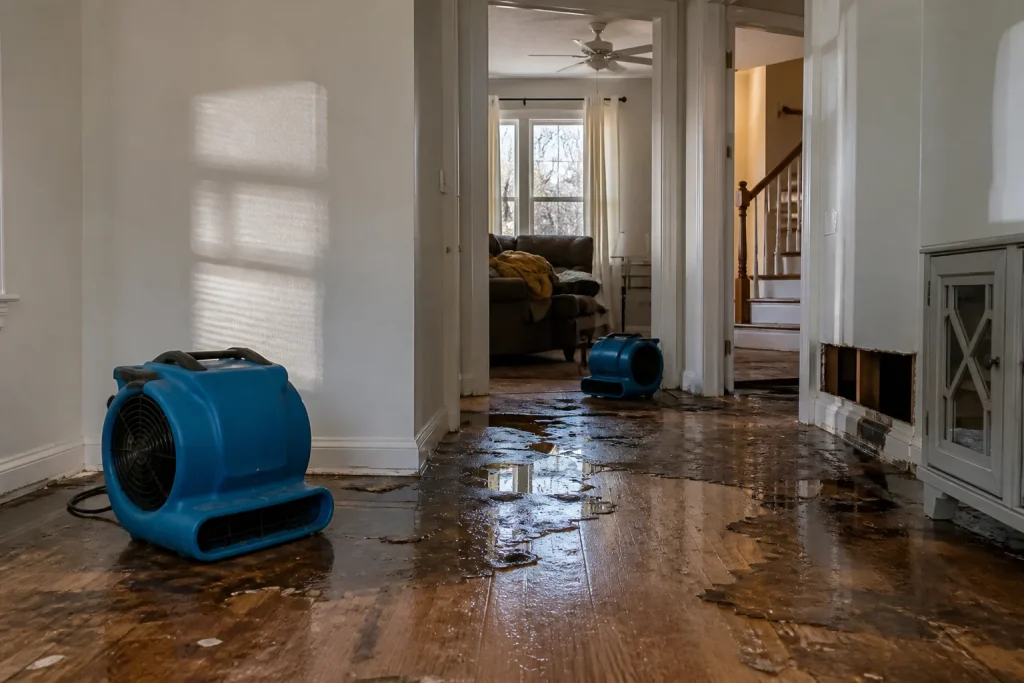
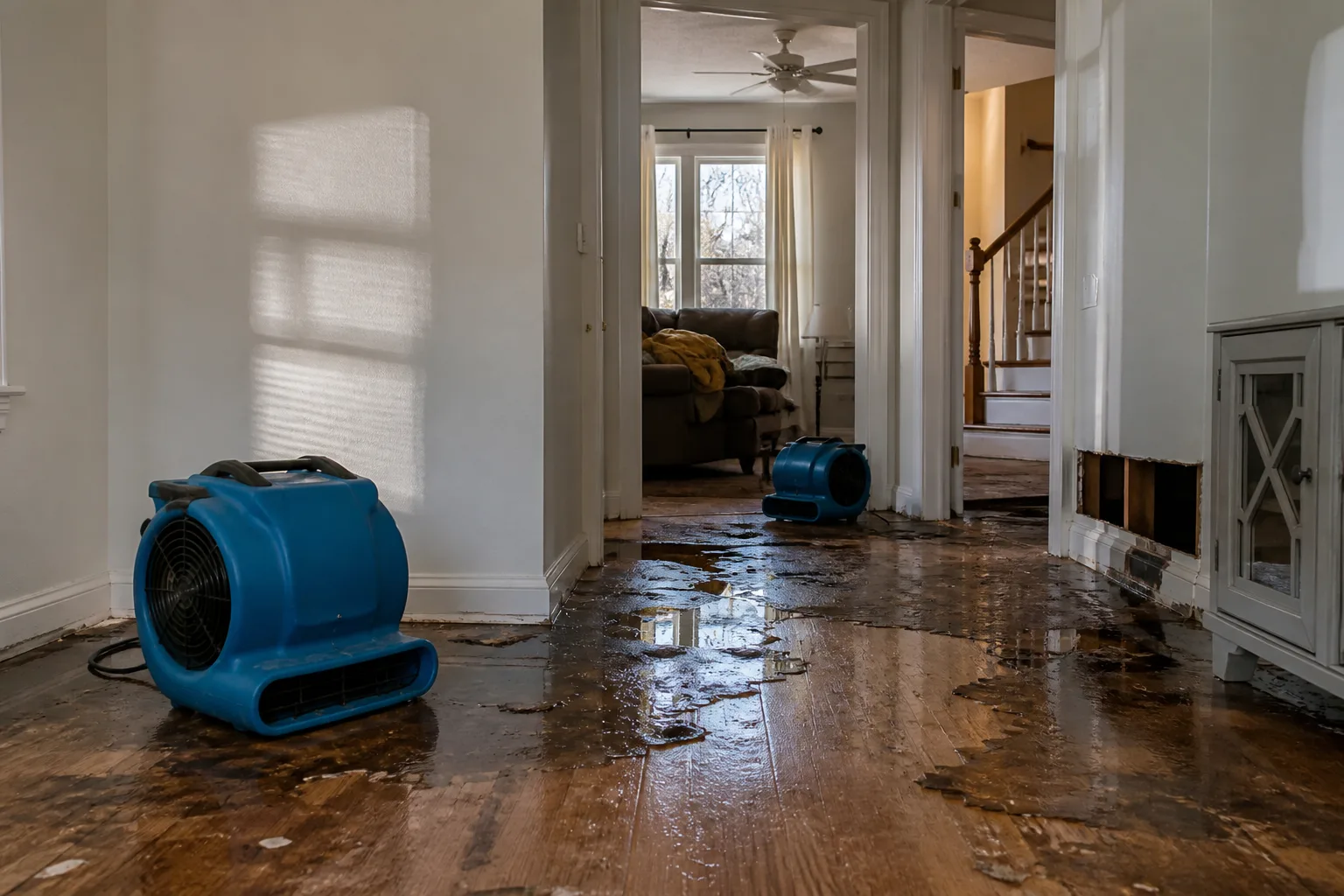
Step 3: Ventilate, but ventilate right. Open windows on opposite sides of the house for cross-flow if outdoor humidity is below 60%. Check your weather app. Bloomington’s summer humidity regularly hits 80%+, and opening windows then traps moisture. In those conditions, close up and wait for dehumidifiers. The one thing you should never do: run a household box fan across standing water. We pulled a job last month over in Elm Heights where the homeowner had three box fans running for six hours before calling us. Those fans aerosolized water into drywall and carpet backing, and what would have been a $2,400 dry-out became a $5,100 mold remediation. Box fans move air; they don’t remove moisture. In Bloomington’s humidity, they often make things worse.
Step 4: Now call. With the source stopped, the scene documented, and ventilation handled, you’re ready to bring in professionals who can actually fix the problem rather than fight an ongoing flood.
Why You Should Call Your Insurance Company Before Your Contractor
This one surprises people, but the sequence matters for your wallet and your control. In Indiana, you have the right to choose your own restoration contractor, but many insurers push “preferred vendor” networks that lock you into one company’s pricing and timeline. Once you agree to their vendor, you’ve often waived your ability to shop the scope or question line items.
When you call your adjuster first, establish these three things:
- That you’re documenting independently and will share your timestamped photos
- That you intend to select your own contractor and want clarity on how out-of-network reimbursement works
- Whether your policy includes Additional Living Expenses (ALE) coverage if the damage makes your Bloomington home unlivable
Get a claim number. Write it down. Then, when you call restoration companies, you can say “I have claim number XXXX with [insurer]” and signal that you’re an informed customer who expects photo-documented assessments and direct adjuster coordination. The contractors who flinch at that language are the ones you don’t want.
We’ve worked with Indiana homeowners for decades, and the ones who maintain control of vendor selection almost always get faster resolution and fewer surprise charges. The Locally home standard is built on this: every brand in our family publishes the owner’s name, a driveable local address, and a verifiable license number before you ever call. You can look us up. You should look everyone up.
What to Tell the Dispatcher So the Right Equipment Shows Up
Not every water damage call needs the same crew. Give your dispatcher these three pieces of information and you’ll change what truck rolls to your Bloomington address:
- Water source and category. “Clean water from a burst supply line” means standard extraction and drying. “Sewage backup” or “water from a backed-up floor drain” means Category 3 contamination, full PPE, and different disposal protocols. The equipment list changes entirely.
- Approximate square footage affected and flooring type. “500 square feet, hardwood and carpet over concrete slab” tells us to bring a Phoenix 200 HT dehumidifier and a Dri-Eaz Extraction Tool for the carpet. “Same footage, original oak over pier-and-beam” in one of Bloomington’s 1920s cottages means we need different drying strategies and moisture meters calibrated for older wood densities.
- Whether power is on and accessible. If your electrical panel is underwater or you’re in one of the low-lying areas near Clear Creek that flood during heavy spring rains, we may need a generator. If you don’t mention this, we might arrive and lose hours sourcing power.
The difference between a crew that extracts and dries in two days versus one that chases moisture pockets for a week often comes down to what was said in that first three-minute phone call.
How to Verify a Contractor Before They Arrive
Bloomington’s had its share of storm-chasing crews rolling through after severe weather, quoting low, collecting deposits, and disappearing. The verification takes under 90 seconds, and every homeowner should do it.
First, check for a Monroe County business address, not just a Bloomington mailing address. Google the address in Street View. Is it a house? A rented mailbox? A legitimate shop? Second, verify the Indiana contractor license through the Indiana Professional Licensing Agency’s online lookup. You need the license number, which any legitimate contractor provides willingly. Third, search the company name plus “complaint” or “lawsuit” and scan the first page of results.
The Damage Restoration in Bloomington brands in our family meet a standard we call Locally Verified: the owner’s name is published, the address is driveable, and the license is verifiable before you call. The price we say on the phone is the price on the invoice. That’s been true since 1997, across every trade and every market we serve. If a contractor won’t give you a license number to look up, that’s your answer.
When to Call a Pro Immediately
Some situations skip the four-step sequence and go straight to emergency dispatch. Call (866) 624-5122 now if:
- Water is actively flowing and you cannot locate or operate the shutoff valve
- Electrical outlets, switches, or panels are wet or submerged
- You smell gas or suspect a gas line breach
- Sewage is present anywhere in the living space
- The damage occurred in a home with occupants who have respiratory conditions, compromised immune systems, or are infants
These are safety-first scenarios. The documentation can happen alongside professional response; the utility shutoffs may need trained hands. Don’t hesitate.
Related services in Bloomington: If you’re dealing with water damage, mold concerns, fire and smoke cleanup, or storm damage repair, our Damage Restoration in Bloomington page covers what to expect from assessment through completion.
The Bottom Line
The first hour after damage is when you have the most leverage over cost, timeline, and outcome. Shut off the source. Document with timestamps. Ventilate strategically, never with box fans in high humidity. Call your insurance to protect your vendor choice. Then call a contractor you can verify, and tell them exactly what they’re walking into so they bring the right tools the first time.
In Bloomington, where summer humidity turns small water problems into major mold jobs in 48 to 72 hours, these steps aren’t just good practice. They’re the difference between a contained dry-out and a six-figure reconstruction. If you’re facing damage now and want help, or just want to walk through your situation with someone who knows Monroe County housing stock, call Locally at (866) 624-5122. Estimates are free, and the person who answers is the person who shows up.
Frequently Asked Questions
Most emergency calls in the Bloomington area see crew arrival within 60 to 90 minutes during business hours, and within two hours overnight, depending on weather and current call volume. The key is giving accurate information when you call so the right truck and equipment are dispatched immediately. Call (866) 624-5122 for current response times.
Most Indiana homeowners policies cover sudden and accidental water damage, though coverage varies for flooding versus pipe bursts versus sewer backup. You typically pay your deductible, and the restoration company bills your insurer directly for covered work. Always confirm your coverage and deductible with your adjuster before work begins, and get a written scope of work with line-item pricing before anyone starts. Call (866) 624-5122 and we can coordinate directly with your adjuster.
For water damage under about 10 square feet on hard surfaces with no structural penetration, DIY drying may be sufficient if you have proper airflow and dehumidification. For anything larger, anything involving carpet or drywall, any Category 2 or 3 water, or any situation in Bloomington’s humid months, professional drying prevents mold colonization that DIY methods often miss. The IFA and RIA standards we follow specify moisture mapping and thermal imaging that consumer equipment cannot replicate. Call (866) 624-5122 for a free assessment if you’re unsure.
A reputable restoration company handles adjuster coordination as part of the job, including photo documentation, written scopes, and direct billing. You should never be stuck playing middleman between your contractor and your insurer. At Locally, every brand in our family provides photo-documented assessments and works directly with adjusters, with the homeowner copied on all communications. Call (866) 624-5122 to discuss how we handle your specific insurer.
Written by the team at Locally, serving Bloomington since 1997.
Need Damage Restoration Help?
Call Locally - licensed & insured, here with fast after-hours help in Bloomington.
(866) 624-5122